

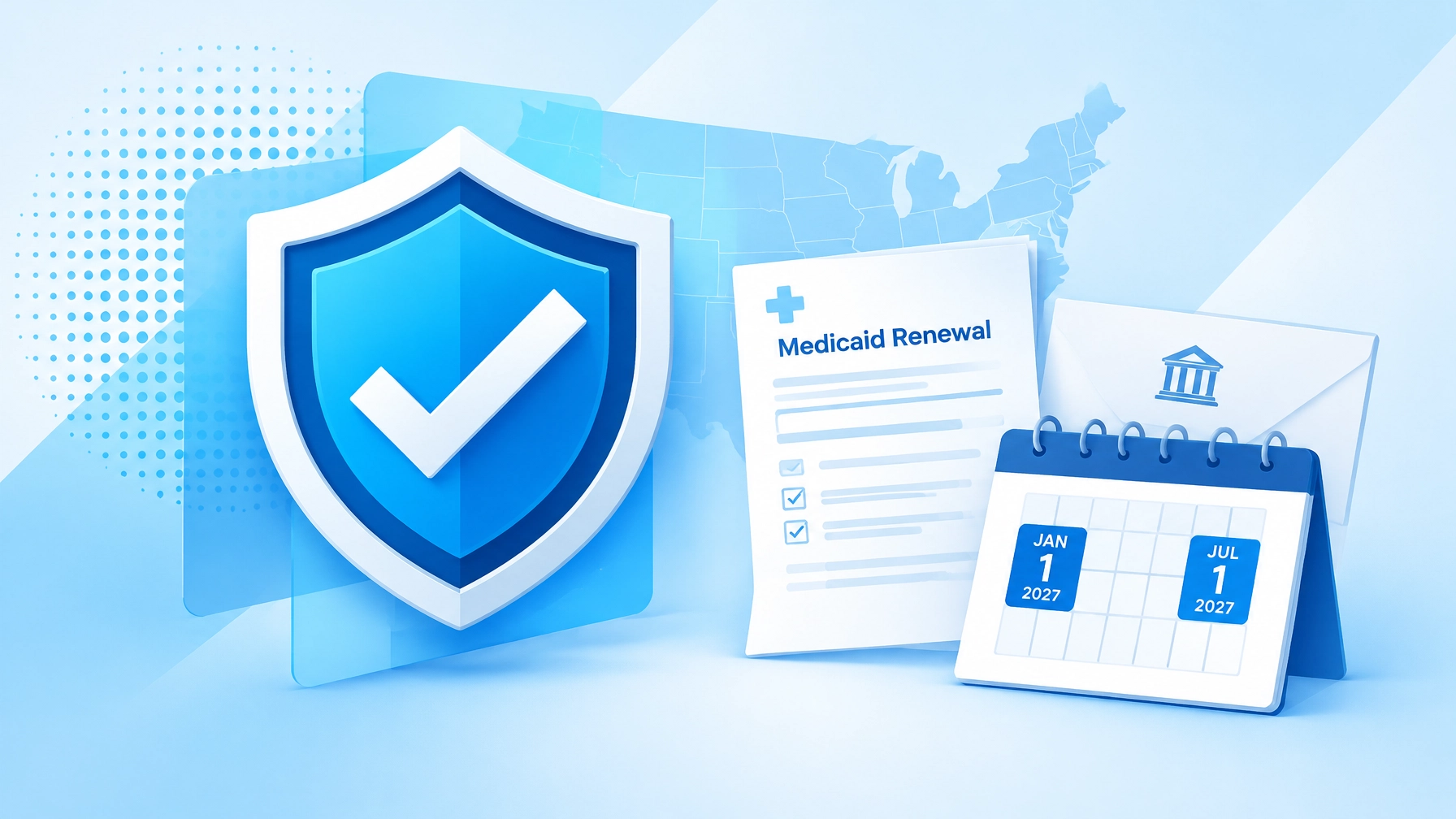
Medicaid renewal in 2027 now has a six-month cushion: states may assess work hours but, if they opt in, cannot end coverage for noncompliance before July.
On November 13, 2026, the Centers for Medicare & Medicaid Services (CMS) announced an optional hold harmless period for the community engagement requirement that begins January 1, 2027. States that obtain CMS approval may pause denials and disenrollments based only on an individual’s failure to demonstrate compliance during the period they adopt. The Associated Press reported on the six-month transition. The announcement is a delay in consequences, not a repeal of the requirement.
What the Hold Harmless Period Changes
CMS’s State Medicaid Director letter SMD #26-006 offers states an option through and including June 30, 2027. A state may choose a shorter period. The option covers applications received and renewals initiated on or before the state’s approved end date.
A state using the option must still assess whether the relevant individual meets the community engagement requirement, including through deemed compliance, or qualifies for an exclusion. If the state cannot verify compliance, it must send a notice of noncompliance and provide 30 calendar days for the individual to demonstrate compliance or show that the requirement does not apply.
The underlying requirement still starts January 1, 2027. For people to whom it applies, qualifying activities include 80 hours a month of work, community service, or participation in a work program; enrollment in an educational program at least half-time; a combination of qualifying activities totaling 80 hours a month; or meeting the monthly income threshold, which is 80 times the federal minimum wage, or $580 per month in 2026.
The assessment still applies at application and renewal. A state’s decision to adopt the hold harmless period affects whether failure to demonstrate compliance can result in a denial or disenrollment during that state’s selected period. It does not suspend other Medicaid rules.
Two Renewal Windows
| Application or renewal timing | If the state has an approved hold harmless period | Potential result based on community engagement |
|---|---|---|
| Application received or renewal initiated January 1–June 30, 2027, or within a shorter state period | The state still assesses compliance and exclusions. | The state may not deny or disenroll solely because the individual has not demonstrated compliance during the approved period. |
| Application submitted or renewal initiated after the state’s hold harmless period ends | The hold harmless option no longer applies. | Denial or termination may follow if the individual is found ineligible for this reason, subject to noncompliance procedures under 42 C.F.R. § 435.558. |
The date that matters is when the application is received or renewal is initiated, not simply the date a decision is issued. A renewal initiated by June 30 may fall within a state’s adopted period even if processing continues later. State notices or the Medicaid agency can clarify how a particular case is dated.

How to Tell Whether Your State Opted In
As of November 13, 2026, it was not clear which states would use the option, and CMS must approve a state's request through its mitigation plan. The state Medicaid agency is the source for a state-specific answer.
- Read the renewal notice. Check for language about community engagement, required documents, the period being reviewed, and the deadline to respond. A notice should distinguish what was verified from what remains necessary.
- Check the state Medicaid agency or the federal state dropdown. The Medicaid.gov state information page provides a state selector for information about upcoming changes. Confirm dates and instructions with the state agency.
- Ask whether CMS approved the state’s mitigation plan. CMS said states intending to use the option beginning January 1, 2027, were asked to notify it by December 11, 2026. That date is a marker for the request process, not proof by itself that a state has opted in. The state agency remains the authority on whether the option is approved and what period it covers.
Example: A Rideshare Driver in Franklin County, Ohio
Consider a 34-year-old self-employed rideshare driver in Franklin County, Ohio. Her hours fluctuate between 60 and 130 per month. She receives a renewal packet dated January 2027. If Ohio initiated the renewal during January, it would fall within the federal date range for the optional period. Whether the protection applies depends on Ohio’s approved plan and the period Ohio adopts; no assumption should be made that Ohio opted in.
The packet may identify the months being reviewed, information already verified, any missing details, and a response deadline. She should check the notice for the exact measurement period and the state’s requested documentation. Monthly work records, app statements, trip logs, and records of other qualifying activities may help document her circumstances. The state should be asked what it can verify through its existing data before additional paperwork is submitted.
Her 60-hour months may not meet the 80-hour activity standard on their own. Months at 80 hours or more may satisfy that standard, subject to the state’s assessment and accepted records. She may also meet another qualifying route, such as the income threshold or a combination of activities. Eligibility for an exclusion should be checked separately.
If the state cannot verify compliance or an exclusion, it must send a noncompliance notice and allow 30 calendar days for her to respond. If Ohio has an approved hold harmless period that covers her January renewal, the state may assess her case and issue the notice but cannot end her coverage solely because she has not demonstrated compliance during that period.
If Ohio does not adopt the option, the requirement may be enforced from January 1, 2027. Her worst case on the work requirement alone would be a finding that she has not met it or qualified for an exclusion, followed by a noncompliance notice and a chance to respond. If she does not resolve the issue within the applicable process, coverage could be denied or terminated for that reason. A fluctuating schedule alone does not establish that outcome; the state must assess her actual information and any applicable exclusions.
Renewal Record Checklist

- Do not ignore the renewal packet. Record the return deadline and the months covered by the assessment.
- Document hours monthly. Keep work, community service, training, education, and other relevant records in a dated format.
- Review every exclusion category. Check whether the requirement applies, including exclusions for parents or caretakers of children under 14; people who are medically frail; pregnant and postpartum people; veterans with total disability ratings; former foster youth; American Indians and Alaska Natives; people participating in SNAP or TANF work requirements; and people participating in drug or alcohol treatment.
- Respond within 30 calendar days if a noncompliance notice is issued. Provide the requested proof or explain why the requirement does not apply.
- Keep the noncompliance notice and a copy of every response and document submitted.
- Ask the agency what verification data it already has. CMS encourages states to maximize automated verification and provide clear, timely notices about what has been checked and what is still needed.
- Ask about self-attestation for medical frailty where the state allows it. A federal court vacated a narrower medical-frailty rule on October 29, 2026; CMS’s letter notes that states’ obligation to work toward compliance does not include implementing the portion of regulations the court vacated.
- Check the Marketplace deadline if coverage ends. People who lost Medicaid or CHIP in the past 90 days may qualify for a Special Enrollment Period, subject to applicable requirements. Review the HealthCare.gov Special Enrollment Period information.
What Can Still End Coverage During the Period
The hold harmless period applies only to the community engagement condition. It does not prevent a denial or disenrollment based on another eligibility factor. Coverage may still end if income is over the applicable limit, household composition changes affect eligibility, a renewal packet is not returned, or another Medicaid rule is not met. CMS states that states may not suspend decisions based on those other factors under this option.
What the Timing Means for Renewal Planning
The federal option creates different timelines across states. During an approved hold harmless period, a person may be assessed and receive a noncompliance notice without losing coverage solely on that basis. Once the state’s period ends, the same type of finding may lead to denial or termination after the required procedures. As a result, the practical risk shifts toward applications and renewals initiated after the state’s selected end date, which may be earlier than July 1.
Paperwork remains consequential during the pause. States must continue assessing compliance and exclusions, and a notice may still require a response within 30 days. The October 29 medical-frailty ruling also changes how that exclusion is defined. The court ruled that the federal government could not require a condition to limit a person’s ability to work or volunteer as a condition of meeting the statutory definition. The pause therefore does not remove the need to identify applicable exclusions or respond to requests for information.
The policy remains subject to change. The new Congress convenes in January, and the medical-frailty ruling is part of the evolving legal context. Neither development changes a state's approved period or the terms of an individual notice on its own. The state agency's instructions and the applicable federal procedures remain the operative records for a specific renewal.
KFF’s tracker identifies 44 states, including D.C., with affected adult groups subject to the requirement. KFF also reports Congressional Budget Office estimates that the 2025 reconciliation law reduces federal Medicaid spending by $911 billion over ten years, with $326 billion attributed to the work requirement, and estimates 5.3 million additional uninsured people by 2034 associated with that requirement. These are national projections, not individual outcomes. KFF also reports that most people subject to the requirement said they were working or faced barriers likely to qualify for an exemption; about one in five Medicaid adults reported not meeting the requirements and possibly not qualifying for an exemption. The KFF implementation tracker provides additional state-level context.
If coverage ends for a reason unrelated to the work requirement, or a state does not adopt the option, a licensed agent can review Marketplace and private coverage options; state agent listings are available, and an agent’s license can be confirmed with the state insurance regulator.